


| I’ve traveled all over North America in the past 12 months, and I’ve met a lot of people who were eager to put 2017 in the rearview mirror. But before we bury it, there were plenty of wins we can build on and valuable lessons that will make this Brotherhood stronger. First, we welcomed 60,000 new members to the IBEW. That makes four years running that our Brotherhood has grown. A-membership is at an all-time high. There were spectacular successes: 1,400 workers at Baltimore Gas & Electric, 400 freelance sports production workers in New England and more than 2,000 DirecTV workers all joined our ranks. But as big as these victories were, together they were only about 6 percent of our total growth. Most of our wins were the result of a humbler persistence spread across the continent, 10 to 30 workers at a time. We’re also delivering for new members after they join. Just one example: in 2016 we won one of the largest organizing victories in the South when workers at Electrolux’s Nashville, Tenn., plant voted to organize. In 2017, we signed their first contract. I can’t overstate how this contract will change their lives or the seismic shock it sends to workers across a part of the country where unions have long struggled. The IBEW is built on the idea that our members do best when our employers are successful, and we have a partnership built on trust and respect. So I am proud to have renewed contracts and relationships this year with some of our oldest partners, including CBS, Exelon and Florida Power & Light, to name just a few. We even recently recorded a commercial with AEP CEO Nick Akins lauding the benefits of working with the IBEW and using the Code of Excellence. But some of the best news I get each year is hearing how our members lift their communities. Sometimes the scale is huge, like the tens of thousands of utility members that pulled Houston, Miami and the Caribbean back into the light after Hurricanes Harvey, Irma and Maria. Other times, though we may touch fewer lives, the gratitude is just as deep, like when a handful of St. Louis Local 1 members stepped up and saved Little League for dozens of young players. Even in the world of politics, where news for union members and working families has been grim, we still had some successes. We beat back right-to-work legislation in New Hampshire. Dozens of IBEW members around the U.S. and Canada were elected to office. We saved project labor agreements for government-funded infrastructure in many states, counties and cities. And in Illinois and New York we helped pass legislation that kept carbon-free, reliable nuclear energy plants operating, saving thousands of IBEW jobs. Even with all these successes, no reasonable person would look around and think we were in the clear. We gained 60,000 members, but lost tens of thousands to layoffs, outsourcing, right-to-work and retirements. This year, we have seen that persistence pays off, that we can win victories big and modest and we should be unstoppable going after both. 2018 will bring more challenges, and with the mid-term elections in November, even more opportunities to improve the lot of working families. It’s good to pat ourselves on the back for a job well done. But it’s a new year now, and we have work to do.
Also: Cooper: GOP’s Tax Scam |
|
Latest News
Congratulations on your Retirement Brother Power!
First District International Representative Michael Power retired Oct. 1, capping almost 50 years of service. Brother Power was initiated into St. John’s, Newfoundland and Labrador, Local 2330 in 1970, then transferred to Churchill Falls Local 2351 in 1972 so he could do electrical maintenance work for the local utility company. In 1976, he was elected president and business manager, a position he held until 1992 when he was appointed international representative.
“I have nothing but the greatest respect for Mike,” said Local 2351 Business Manager Dean Harris. “He’s incredibly knowledgeable and just an all around good guy.”
Power served on the pension, grievance, apprenticeship and labor management and negotiations committees at Local 2351. He was also well versed in provincial labor laws even though his focus was Newfoundland and Labrador, his home province, said International Representative Brian Matheson, who has known Power since 1978.
“If you needed someone to help you, whether it was developing training courses for shop stewards or business managers, or with negotiations or investigations, you asked for Mike,” Matheson said. “He was good at everything he did.”
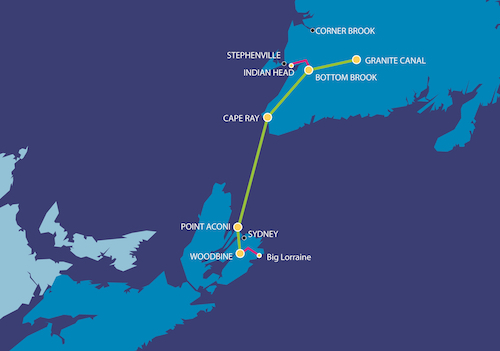
Among his numerous achievements, Power says the one that stands out was when he negotiated the contract for the Muskrat Falls transmission project, a CA$8.5 billion hydro project that connects Newfoundland to Labrador and its hydroelectric power, and will eventually extend south to Nova Scotia. All the electrical transmission, switchyard and support construction work was done solely by the IBEW under a special project agreement, employing more than 3,000 members during peak construction.
The project, which was done under the Code of Excellence at the request of the company, Nalcor, began in 2013 and is expected to finish in 2019.
“It is a massive job for us,” Power said of the project to build a generating station with a capacity of more than 800 megawatts.
Power says he’s enjoying having more time to hunt and work on projects around the house, as well as spending time with his wife, Tina, and his children and grandchildren. But he does miss his IBEW brothers and sisters, he said.
“I miss the camaraderie,” said Power, who also served as a reserve officer in the Royal Canadian Navy. “I made friends across Canada and the U.S. Being an international representative was a very rewarding and enjoyable career.”
Power said he considers his work with the IBEW to have been more than just a job.
“A career is something that you live and breathe. It’s part of your person,” he said. “It doesn’t just end when you clock out. Whether it was Sunday night or Monday morning, I was there.”
The IBEW officers, members and staff are grateful to Brother Power for his years of service and wish him many happy years of retirement.
MoreIBEW Tells Saskatchewan Politicos ‘No’ on Pay Cuts
Business Manager Jason Tibbs said Regina, Saskatchewan, Local 2067 has had a non-adversarial relationship with the conservative provincial legislature for the last several years. The relationship with SaskPower, its largest employer, has been a good one.
That made it a little awkward when provincial leaders called for a 3.5 percent reduction in public sector worker pay earlier this year to cut into a $1.2 billion budget deficit.
“It’s a distraction,” Tibbs said.
But Tibbs and those around him didn’t overreact. In October, Local 2067 became the first Saskatchewan public workers union to vote down a proposed wage cut since the government made its request. It rejected a proposal from SaskPower, but negotiations continue and both sides are determined to reach a fair agreement, he said.
About 80 percent of the 1,700 Local 2067 members employed by SaskPower voted against the proposal, which also included no raises for the next three years. Being the first union to vote down a contract briefly put Tibbs and his members in the spotlight. He sat for an interview with the CBC.
But now, he hopes to negotiate a new contract outside of the public glare. Local 2067 members have been working without one at SaskPower since Dec. 31, 2016, but they have seen a 67 percent increase in total compensation during the last 10 years, Tibbs said. The company also has added about 300 employees covered by the agreement during that period, he said.
“We’re hoping to draw as little attention as possible to ourselves and our bargaining units,” he said.
The move also was applauded by other unions, who said it inspired the labour movement and encouraged provincial leaders to back off the plan. Indeed, Saskatchewan Finance Minister Donna Harpauer told reporters the government’s original request “doesn’t look promising.”
“If we had said no, we’re not going to bargain under these conditions, I am sure we would have seen legislation [from the provincial legislature] forcing the cuts,” Tibbs said. “But now, we’re not seeing any desire to do that.
“When government spending gets out of control and deficits are going up, one of the things they like to tout is fiscal management. They think if they make the story big enough and get the unions into a fight, they’ll sway the public’s perception and people won’t look at the books.”
Premier Brad Wall, who is leaving his post this month after nearly 11 years, originally made the proposal to cut wages last March. He added that he would respect the collective bargaining process and that any cuts for union-represented workers would have to be negotiated.
Labour leaders pushed back, saying that cuts should not be on the backs of working families and suggested renegotiating contracts built with public-private partnerships. Even though Tibbs downplayed the significance of Local 2067’s vote, other Saskatchewan labour leaders praised it.
“If it wasn’t clear before, it should be now,” Larry Hubich, president of the Saskatchewan Federation of Labour, told the CBC. “It is highly unlikely any worker will allow the Saskatchewan Party government to pickpocket their hard-earned wages.”
The Saskatchewan Party has been the province’s governing party since 2007 and controls 49 of the legislature’s 61 seats. It is not officially aligned with any national political party, but many provincial legislators are members of the Conservative Party, and most observers consider it to have a conservative philosophy.
“On a number of occasions, conservative members have stood up on the floor and commended the work our brothers and sisters have done,” Tibbs said.
For more from the Electrical Worker, click here.
More