


Key Statistics | Key Messaging | Key Actions | Resources
From November 25 to December 10, the 16 Days of Activism against Gender-Based Violence brings attention to efforts around the world to end gender-based violence in all its forms. The United Nations (UN) 2026 global campaign theme is “UNiTE to End Violence Against Women: Ensure Justice, Protect Survivors, End Impunity.”
The Canadian Labour Congress (CLC) is focusing its campaign on the impacts of gender-based violence at work and on making work safer for everyone. Its campaign, Prevent, Respond, Support: Unions Rise Up Against Gender-Based Violence, highlights union-led efforts to challenge harassment and violence at work and in our communities. We’re asking every local to take part.
The 16 Days of Activism against Gender-Based Violence is an annual global campaign to raise awareness and encourage action to prevent and end gender-based violence. It runs from November 25, the International Day for the Elimination of Violence against Women, through December 10, Human Rights Day, and includes December 6, the National Day of Remembrance and Action to End Violence Against Women. The campaign links efforts to end violence against women with the broader protection of human rights.
Workplace violence and harassment include actions or threats that harm, intimidate, or undermine a worker. They can be physical, psychological, sexual, or economic, and can happen once or repeatedly. Examples include threats, unwanted sexual comments or contact, bullying, and using someone’s position to intimidate or disadvantage them. Gender-based violence and harassment target people because of their sex or gender or affect them disproportionately because of it.
The evidence from our own sectors is hard to ignore:
- Statistics Canada found that in 2020, 47% of women in trades, transportation, and equipment operation reported inappropriate sexualized behaviour at work, compared with 19% of men. In natural and applied sciences, the figures were 32% of women and 12% of men, and 29% of women in manufacturing and utilities reported this behaviour.[1] These findings are supported by the Is Work Safer report published in March 2026 by the CLC and Western University.
- A Canadian study of welders and electricians found that 60% of women and 32% of men reported being harassed. Among the women, 44% reported sexual harassment during their apprenticeship.[2]
These figures describe our apprentices, our members, and the people we want to bring into the IBEW. Most of this research measures harassment and unwanted sexual behaviour rather than every form of violence, so it may not capture the full picture.
Our union and many of the sectors we represent have historically been male-dominated. That history has shaped our locals, meetings, workplaces, and culture. We can build on the strengths of our union while making sure every member can work safely, participate fully, and succeed. A safer, more respectful union is stronger for everyone: it helps us retain skilled workers, support apprentices, and bring more people into our sectors of work and our union. This is not about taking opportunities from current members; it is about making sure every member can contribute and thrive. Local leaders have an important role in setting that standard.
The CLC is calling on government to take action to make work safer for everyone. Its campaign also highlights third-party violence and harassment, a serious concern in some workplaces our members serve. We ask every local to join the campaign and help make workplaces and communities safer for all.
From November 25 through December 10, we ask every local to take part in the following ways:
- Mark the days visibly. Wear orange on November 25, the UN Campaign colour, and a white ribbon on December 6, the National Day of Remembrance and Action on Violence Against Women. Host or join a vigil on December 6.
- Review your own space. Confirm that your local has a clear, confidential way for members to raise harassment or violence in the local, at meetings, and at union events, and that officers know how to respond. Our own members’ trust in how complaints are handled is part of the problem we need to fix.
- Start a bargaining conversation. Bring one issue to your next bargaining committee: domestic violence leave, protection from third-party violence leave, or stronger harassment and violence language. Leave entitlements vary by province, and we are putting together a comparison to help.
- Spread the word. Share Prevent, Respond, Support: Unions Rise Up Against Gender-Based Violence on your local’s social media and encourage members to share it.
- Promote the national survey. Encourage every member and worker in your community to complete the CLC’s second National Survey on Domestic Violence in the Workplace. Share the survey, printable postcard, and poster with members. Complete the survey.
- Add your voice. Join the CLC in calling on government to take action and make work safer for everyone. Encourage members to add their voices too. Write to your MP.
- Promote the CLC webinar. Register yourself for and share information about the December 1 webinar at 1 p.m. ET, highlighting the role of unions in challenging gender-based violence at work and in our communities. Registration for this webinar is open now: Register for the webinar. (This webinar will take place in both English and French, with simultaneous interpretation available.)
- Support local events. Find out what 16 Days of Action events are happening in your area and ask organizers what support they need. Locals can show up with flags, banners, and posters; provide practical support such as printing or refreshments; and share information at union and community events about gender-based violence and harassment at work. This includes third-party violence and harassment, alongside other forms of workplace violence and harassment.
Locals can choose actions that fit their members’ workplaces and communities. We also encourage you to invite women and gender-diverse members to help shape your local’s activities, if they wish to participate. The responsibility for preventing and addressing harassment belongs to all of us, and especially to the leaders who set the standard.
Change in a union happens when local leaders decide it matters. Thank you for taking this on.
In Solidarity,
Matthew J. Wayland
International Vice President
The 16 Global Days of Activism Against Gender-Based Violence is a global initiative to highlight advocacy initiatives around the world to end gender-based violence in all its forms.
In 2026, the global campaign theme is UNiTE to End Violence Against Women: Ensure Justice, Protect Survivors, End Impunity.
The Canadian Labour Congress (CLC) is focusing its campaign on the impacts of gender-based violence at work and on making work safer for everyone. Its campaign, Prevent, Respond, Support: Unions Rise Up Against Gender-Based Violence, highlights union-led efforts to challenge harassment and violence at work and in our communities. We’re asking every local to take part.
Key Statistics
47% | 37% | 33% |
47% of women in trades, transportation, and equipment operation reported inappropriate sexualized behaviour at work, compared with 19% of men. In natural and applied sciences, the figures were 32% of women and 12% of men, and 29% of women in manufacturing and utilities reported this behaviour.[3] | 37% who experienced sexual harassment and violence identified a coworker as a perpetrator. [4] | 33% of respondents who experienced sexual harassment and violence and did not report it cited fear of negative consequences. [5] |
Key Messaging
PREVENT | RESPOND | SUPPORT |
|
|
|
FOR LOCAL UNIONSReview your own space. Confirm that your local has a clear, confidential way for members to raise harassment or violence in the local, at meetings, and at union events, and that officers know how to respond. Our own members’ trust in how complaints are handled sets the foundation to fix the problem. | FOR LOCAL UNIONSTake complaints seriously and ensure a timely investigation process is followed through. Have a “Zero Tolerance” policy for inappropriate behaviour and clear consequences for those who are found to violate these standards. | FOR LOCAL UNIONS
|
Key Actions
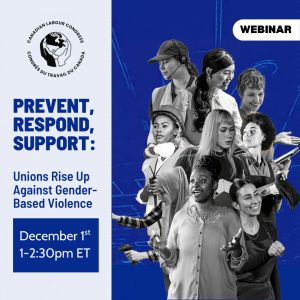 | REGISTER FOR THE WEBINARRegister for and help promote the CLC’s webinar, Prevent, Respond, Support: Unions Rise Up Against Gender-Based Violence, on December 1 at 1 p.m. ET. The webinar highlights the role of unions in challenging gender-based violence at work and in our communities. |
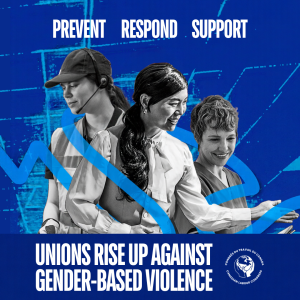 | SPREAD THE WORD ON SOCIAL MEDIASpread the word about Unions Rise Up Against Gender-Based Violence. The CLC has prepared branded posts and captions you can share on social media. |
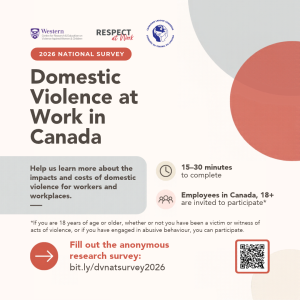 | COMPLETE THE NATIONAL SURVEYEncourage every worker you know to complete the 2nd National Survey on Domestic Violence in the Workplace. |
| ADD YOUR VOICEJoin the CLC in calling on the government to make work safer for everyone, and encourage everyone in your union to do the same. The CLC has prepared a letter you can submit online. |
Resources
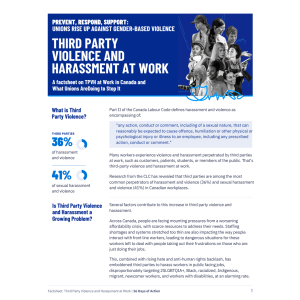 | THIRD PARTY VIOLENCE AND HARASSMENT AT WORKA factsheet on TPVH at Work in Canada and What Unions Are Doing to Stop It
|
 | RESEARCH REPORT – Is Work Safer?The Second National Survey on Harassment and Violence at Work in Canada |
 | DOMESTIC VIOLENCE AT WORK RESOURCE CENTREMore information and educational resources have been put together by the CLC and are accessible through their web page. |
[1,3] Government of Canada, Statistics Canada (2021, August 12). The daily — In 2020, one in four women and one in six men reported having experienced inappropriate sexualized behaviours at work in the previous year. https://www150.statcan.gc.ca/n1/daily-quotidien/210812/dq210812b-eng.htm
[2] Galarneau, J.-M., Durand-Moreau, Q., & Cherry, N. (2024). Reported harassment and mental ill-health in a Canadian prospective cohort of women and men in welding and electrical trades. Annals of Work Exposures and Health, 68(3), 231–242. https://doi.org/10.1093/annweh/wxad083
[4] Berlingieri, A., & Clerke, A. S., with the Canadian Labour Congress. (2026). Is work safer? The second national survey on harassment and violence at work in Canada (p. 17, « Who is Behaving Abusively? », figure 15). Centre for Research and Education on Violence Against Women and Children, Western University. https://documents.clcctc.ca/PAC/2026/March2026-HarassmentViolenceReport-EN.pdf
[5] Berlingieri, A., & Clerke, A. S., with the Canadian Labour Congress. (2026). Is work safer? The second national survey on harassment and violence at work in Canada (pp. 21–22, “Barriers to Reporting”, figure 22). Centre for Research and Education on Violence Against Women and Children, Western University. https://documents.clcctc.ca/PAC/2026/March2026-HarassmentViolenceReport-EN.pdf.