


The work done by Halifax, Nova Scotia, Local 1131 members literally has national security implications. That’s why their leadership argued for years that it should be certified with the highest designation of quality.
It now has just that.
Local 1131 members, who are electricians servicing the Royal Canadian Navy’s eastern fleet at the Cape Scott maintenance facility, are now required to have a Red Seal certification, the common trades designation used across the country that assures that skilled work is done at the highest level.
It will be included in ongoing apprenticeship training specific to the industry provided by the Royal Navy and signatory contractors.
“My response has always been, ‘We work for the federal government,’” Business Manager Chris Johnson said. “If we do not hold ourselves to the highest standard, who will?”
Red Seal training was previously offered but done away with sometime in the 1990s, Johnson said. That decision had a real-world cost for Local 1131 members because, depending on the federal government’s level of defense spending, they sometimes must leave the local to find work.
Having the Red Seal designation made it easier to become part of IBEW construction locals in Canada. Without that training being provided, they had to take unpaid time off to receive it outside the harbour.
Rear Adm. Josée Kurtz, commander of Maritime Forces Atlantic, approved the change after a recommendation from Capt. Eric McCallum, commanding officer at Cape Scott.
“The Red Seal means everything,” said Johnson, who works in above-water weapons systems in addition to his business manager duties. “Now it’s reality.”
Chester MacKenzie joined Local 1131 when he was hired to work in the harbour in the early 1990s. He loved the job but has had to leave it for years at a time when defense spending slowed.
Fortunately, he earned his Red Seal designation early in his career and was able to join Halifax Local 625, an inside construction local, and maintain steady work. He’s now back servicing Navy vessels and Local 1131.
“I applaud Chris and our executive council for fighting the good fight and getting the Red Seal program back in place and to where it is required for our apprentices,” he said.
So does First District International Vice President Russ Shewchuk.
“This is a strong example of what sustained union advocacy can achieve,” Shewchuk said. “Chris stayed the course to restore a credential recognizing the value of RSE electrical work and ensuring apprentices get the same training. This is an important win for IBEW members working at Cape Scott.”
MacKenzie and his Local 1131 brothers and sisters work alongside members of Halifax Local 1133, who perform the maintenance work on the same vessels. (Local 1133 members were featured in the April 2020 issue of the Electrical Worker.)
Local 1133 originally represented both the maintenance workers and electricians, but the electricians requested a separate bargaining unit and Local 1131 was granted its charter in 1999.
“Both locals work closely together and well together, but it was needed,” MacKenzie said. “We are certified electricians geared toward more industrial marine work. They are more systems and electronics technicians.”
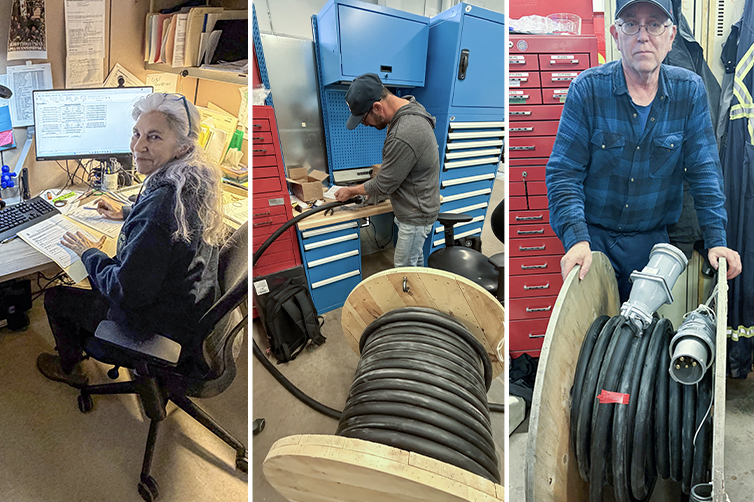
Canada has seen an increase in defense spending under the current Liberal government as it works to increase its commitment to NATO and address Arctic security. That means more work for Local 1131, which has about 110 members across nine shops, covering areas such as fiber optics, sub-electrical and ship cabling, and about 20 percent are women.
MacKenzie, who works in the cable shop, said the “uniqueness and diversity” of work that Local 1131 members perform makes it a special place to be.
“You might get to work on a weapons system, radar system and power generation on the same day,” he said. “It’s a full spectrum of troubleshooting and repair, and you’re fulfilling your support to the Canadian military.”
*This article was originally published in the July 2026 issue of The Electrical Worker.