


IBEW Canada Leadership Driving National Dialogue on Standards, Trade, and Safety

Brothers and Sisters,
Following the election of a new Liberal government last spring, IBEW Canada has been engaged in critical policy-related discussions with federal and provincial governments to ensure a strong voice on behalf of skilled trades workers.
We continue to leverage strong relationships both within Canada’s Building Trades Unions (CBTU) and directly with government officials to secure tangible benefits for the membership. More recently, these efforts have focused on national safety harmonization, project labour agreements, and international trade negotiations, with our overall goal being to shape an environment where union standards are recognized as the industry benchmark.
I am pleased to share an update on our recent efforts.
Supporting National Efforts to Harmonize Safety Training, with Ontario as a Catalyst
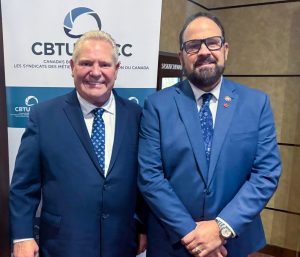
 As governments advance large-scale infrastructure and resource development, the need for a mobile, job-ready workforce has become more pronounced. However, safety certification requirements vary by province, creating unnecessary barriers for skilled tradespeople. These barriers add to project costs, and result in delays and duplication while doing little to enhance worker safety.
Working alongside the CBTU, we remain engaged in discussions with government partners regarding the establishment of a consistent, high-standard approach to safety training that can be recognized across jurisdictions. Central to this effort is ensuring that any harmonized framework is built on the strongest standards, many of which already exist within union training systems.
Ontario has emerged as a key catalyst in this conversation, having been the first province to develop an “As of Right” credential recognition framework in partnership with regulatory bodies. As such, the province is positioned to play a leadership role as governments consider broader harmonization efforts tied to major projects and workforce mobility.
In recent engagement with both provincial and federal officials we reinforced the value of union-led training, highlighting the readiness of our unionized workforce. We also demonstrated how harmonization can support productivity while maintaining the highest levels of health and safety.
While government processes rarely move quickly or publicly signal next steps, we view these ongoing engagements as important work that strengthens both the electrical industry and the broader construction sector.


Securing Stronger Labour Standards on Canada’s Major Projects
In close collaboration with CBTU, we are actively driving discussions at the highest levels of government to secure robust labour standards for all federally supported major projects.
As the Federal Government moves forward with a vision for national infrastructure development, we are advocating for formal commitments that ensure such projects are built using the highest standards of skilled labour and fair compensation. Our goal is to establish a framework that makes union conditions the default industry standard for all major projects.
Central to these discussions is a proposed framework that outlines two critical, measurable outcomes:
- Prevailing Wages: Ensuring that all tradespersons on major projects are remunerated in accordance with established, operative multi-employer and CBTU affiliate collective bargaining agreements, recognizing these as the industry standard.
- Apprentice Ratios: Mandating that a minimum of ten percent (10%) of the total tradesperson hours on any major project is performed by registered apprentices in the Red Seal and all other recognized trades, supporting career development and future workforce needs.
Engagement has been productive, emphasizing that achieving these commitments would solidify a unanimous, collaborative partnership between organized labour and the government to “build Canada together.”
While we remain in the initial stages, we view this high-level engagement as essential work, demonstrating the value of strong union representation and influence in national policy making.
Continued collaboration between unions, governments, and industry partners will be essential to delivering a harmonized approach that benefits workers, projects, and the broader Canadian economy.
Advocating for “Union-Strong” Canada at Federal CUSMA Roundtable

In close partnership with CBTU, we continue to ensure the voices of skilled tradespeople are front and centre in crucial federal discussions that shape Canada’s economic future. This ongoing engagement included participation in a high-level roundtable focused on the upcoming joint review of the Canada-United States-Mexico Agreement (CUSMA).
Trade agreements have a significant impact on Canadian jobs, industrial capacity, and the viability of major infrastructure projects across the country. Recognizing this, the Honourable Dominic LeBlanc, Minister of Public Safety, Democratic Institutions and Intergovernmental Affairs, invited myself and other building trades leadership to participate in a vital consultation process.
A key takeaway from the discussions was the clear alignment between the federal government and the established labour movement regarding consultation with union organizations. The government affirmed its focus is on working with legitimate, recognized trade unions, like those affiliated with the CBTU structure, providing clear definition to the term “union” within the official federal context.
IBEW Canada remains committed to sustained engagement with all levels of government to build Canada union-strong. These meetings are part of a continuous effort to advocate for our members and ensure that a strong, skilled, and recognized union workforce is the foundation of Canada’s economic future.
We look forward to keeping you updated as these and other legislative goals progress.
In Solidarity,

RUSS SHEWCHUK
International Vice President
IBEW Canada